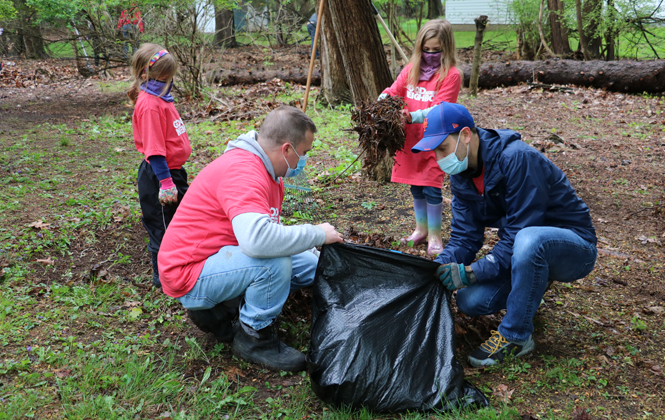

Clean up any sand or gravel you may have used for traction on winter ice. This will help keep culverts and storm sewers clear for downstream waters.Â
Driveway pipes, culverts and catch basins should be kept clear of yard waste or garbage. Rake up any accumulation of leaves or debris.Â
Remove anything that has the potential for clogging up the system, such as a child's ball, recycling items such as milk jugs, etc.Â
Swales should be kept clear to allow water to drain. Do not plant flowers or trees in drainage areas and do not spread grass clippings in the swale areas.
Volunteer Opportunities
If you would like to support the work of the Town's watershed committee by volunteering to help observe water and drainage conditions in your watershed district, please contact the engineering department at engineer@penfield.org or(585)340-8681.
Aeration - To allow circulating air to reach or penetrate the soil.
Bedrock - A general term for any consolidated rock.
Catch basin - A device or receptacle at the entrance of a sewer designed to prevent obstructive material from entering and blocking the sewer.
Compacting - Describes dense, firmly packed soil that resists water absorption.
Culvert - A covered channel that carries water underground; an arch, bridge, or part of a road that covers a culvert.
Easement - A limited right to make use of a property owned by another, for example, a right of way across the property
Erosion - The wearing away of the land surface by running water, wind, ice, or other geological agents, including such processes as gravitational creep.
Groundwater - The supply of freshwater under the earth's surface in an aquifer or soil.
Habitat - The specific environment in which an organism lives and on which it depends for food and shelter.
Leaching - The downward transport of dissolved or suspended minerals, fertilizers and other substances by water passing through a soil or other permeable material.
Percolation - Water that moves through the soil at a depth below the root zone.
Precipitation - Moisture falling from the atmosphere in the form of rain, snow, sleet or hail.
Root zone - The depth of soil penetrated by crop roots.
Runoff - The portion of rainfall, melted snow, or irrigation water that flows across ground surface and is eventually returned to streams. Runoff can pick up pollutants from the air or the land and carry them to streams, lakes, and oceans.
Sediment - Fine soil or mineral particles that settle to the bottom of water or are suspended in it.
Spring - A place where ground water naturally comes to the surface resulting from the water table meeting the land surface.
Storm sewer - A large drain built to carry away excess water from a road during heavy rain.
Swale - A depression between slopes that provides for drainage.
Surface water - Water found over the land surface in streams, ponds, marshes.
Watershed - The land water flows across or under on its way to a stream, river or lake.
Water table - The water level of an unconfined aquifer, below which the pore spaces are generally saturated.
Wetlands - Wetlands are lands where saturation with water is the dominant factor determining the nature of soil development. They also can be identified by unique plants which have adapted to oxygen-deficient (anaerobic) soils. Wetlands influence stream flows and water quality.
Town-wide Drainage,
Town-wide stormwater drainage relates to the conveyance of surface water, including but not limited to creeks, streams, wetlands, roadway culverts or storm sewers. These facilitates are maintained by the Town of Penfield or the operating authority of the roadway. Except for roadway drainage structures, these facilities may or may not be located on town-owned land or are under an easement to the town. Where there is no easement, the town will require an easement to be granted upon any development project that requires town approval.
General activities associated with managing of regionalized drainage facilities includes, but is not limited to, the following:
Cleaning drainage ditches, removing debris from streams or creeks
Stream bank stabilization or reinforcement
Keeping town drainage studies current
Conduct sub-basin studies, where required
Apply for NYSDEC/US Army Corps permits, where required
Planning and implementation of improvements to mitigate flooding and reduce floodplain acreage
General maintenance of regional detention /retention facilities to ensure that storage and flow is not impeded
Raise and lower water levels in ponds, as required for function
The maintenance of these channels may be done by the town forces, or their contractors, as needed for emergency services or as part of an annual maintenance program. The town will make every effort to obtain a release prior to entering on private property to complete these services.
To report a town-wide drainage problem contact the highway department at (585) 340-8710 or highway@penfield.org.
Localized stormwater drainage relates to the conveyance and storage of stormwater from a subdivision or a large group of properties, including minor swales, creeks, streams, control structures, detention facilities, retention facilities, and storm sewers. These facilities are typically owned by the town or are under easement to the town.
General activities associated with managing of localized drainage facilities includes, but is not limited to, the following:
Cleaning or removal of excessive growth from the drainage ditches
Grass cutting and removal of debris from neighborhood detention/retention facilities
Planning and implementing improvements associated with new development
Storm sewer cleaning or improvement projects
To report a localized drainage problem contact the highway department at (585) 340-8710 or highway@penfield.org.
Site-specific stormwater drainage relates to the conveyance and storage of stormwater from a small group of properties, including minor swales and storm sewers. These facilities are typically NOT owned by the town are NOT under easement to the town.
The town does not manage or maintain these site-specific drainage facilities, unless it is part of an overall regional or localized problem. Property owners are expected to maintain these facilities. Typical causes for these types of problems include, but are not limited to, the following:
Poor lot grading
Low home elevation
Overgrown landscaping
Installation of fences, landscaping, gardens, pools or sheds into drainage swales
Changes to runoff characteristics
Settlement of the land around a structure
Clogged catch basins or field inlets
Improper sump or lateral installations or connections
To report a site-specific drainage problem contact the highway department at (585) 340-8710 or publicworks@penfield.org.
There are three types of stormwater drainage: Town-wide, Localized and Site-Specific.
To report an issue with any of these types of drainage, contact the Town of Penfield Highway Department at (585) 340-8710 or publicworks@penfield.org.
Be sure to include your contact information and to briefly describe the nature of the problem. If you have a digital image of the problem, you may attach a small jpeg file to your email.
When a drainage concern is reported, town staff will assess the nature of the issue and direct the complaint to the appropriate department for investigation. This can include a site visit to review existing conditions, a review of documents, drawings and photographs, and if needed, a topographic survey.
The affected property owners will be kept informed of the status of the investigation and notified of the outcome and recommendation. The following conditions shall be considered in the determination of the best alternative for the situation:
Is the concern town-wide, localized or site-specific?
Does the concern affect a structural or life safety issue?
Has this been a recurring problem?
Does an easement exist?
What conditions led to the problem?
How many parcels are affected by the concern?
Is a NYSDEC or US Army Corps of Engineers permit required?
The Town Board shall be responsible for any final determinations related to appeals form residents. The Town Board may involve an advisory committee for input on certain drainage issues.
If the Town of Penfield determines it is appropriate to complete site-specific drainage improvements, the following conditions must be agreed to by the affected property owner(s):
Property owners grant permission for property access to contractors/town staff
A drainage easement is granted to the Town of Penfield for piping and structures
The property owner shall be responsible to replace or relocate any landscaping or structures disturbed by the work. These shall not be installed within the easement.
The property owner will agree to permit future connections by adjoining property owners
The property owner will hold the Town of Penfield, its agents and employees harmless for any damage as a result of the work
It’s the land water flows across or under on its way to a stream, river or lake. A watershed’s landscape is made up of homes, businesses, farms, forests and roads. Watersheds are everywhere, and our collective behaviors directly affect water quality and drainage downstream from our properties. In Penfield, we have eleven different watershed districts.